
Table of Contents
- BASF MasterSeal SL 1 Review
- Sika Sikaflex 1c SL Review
- Comparing MasterSeal SL 1 and Sikaflex 1c SL
- How to Choose
- MasterSeal SL 1 Applications
- Sikaflex-1c SL Applications
- Application & Dispensing Considerations
- FAQs
Concrete joints need a sealant that can accommodate movement while resisting the environmental conditions to which the joint is exposed. A sealant that is incompatible with the specific application requirements may crack, fail, or wear prematurely. Consequently, sealant selection is critical to the joint's long-term performance.
MasterSeal SL 1 and Sikaflex®-1c SL are two popular sealants used for horizontal concrete joint applications. While they are used in similar applications, their performance capabilities vary in ways that may make one a better choice for your project than the other. Our team reviews both MasterSeal SL 1 and Sikaflex®-1c SL, including their strengths, limitations, and ideal applications.
BASF MasterSeal® SL 1 Review
BASF MasterSeal SL 1, formerly known as Sonolastic® SL 1, is a single-component polyurethane sealant designed primarily for horizontal expansion and control joints in concrete floors and decks. The MasterSeal SL 1 has excellent weatherability, high abrasion resistance, and a movement capacity of ±35% for great long-term performance in difficult environments. It is also self-leveling, so it typically does not require tooling or priming.
Common applications for the MasterSeal SL 1 sealant include sidewalks, parking structures, plaza decks, industrial floors, garages, pavers, and pitch pans. You can purchase the MasterSeal SL 1 joint sealant in various container sizes, including 825-milliliter cartridges, 300-milliliter cartridges, and 2-gallon pails.
Sika Sikaflex® 1c SL Review
Sikaflex 1c SL is an elastic, one-component polyurethane from Sika that is used to seal horizontal expansion joints. It offers accelerated curing, with a tack-free time of one to two hours and a final cure time of approximately three to five days. The Sikaflex 1c SL polyurethane is highly durable, with great resistance to weathering, aging, and jet fuel. It is also self-leveling and pourable for easy application.
Common uses for the Sikaflex 1c SL sealant include sidewalks, balconies, warehouses, plazas, pitch pans, and terraces. It can also be applied to green concrete 24 hours after pouring and damp concrete one hour after getting wet. You can purchase it in cartridges, pails, and drums.
Comparing MasterSeal SL 1 and Sikaflex 1c SL Joint Sealants
Both products are one-component polyurethanes intended primarily to seal horizontal joints, but they offer unique properties that lend themselves to different ideal applications. We outline the key similarities and differences between the MasterSeal SL 1 polyurethane and Sikaflex-1c SL polyurethane to help you better distinguish which product is right for your job.
| Property | MasterSeal SL 1 | Sikaflex-1c SL |
|---|---|---|
| Chemistry | One-component polyurethane | One-component polyurethane |
| Consistency | Self-leveling | Self-leveling |
| Movement capability (ASTM C-719) | ±35% | ±25% |
| Elongation at break (ASTM D412) | 800% | 320% |
| Tensile strength (ASTM D412) | 300 psi | 150 psi |
| Shore A hardness | 25 | Approximately 40 |
| Water immersion | Not intended for continuous immersion | Suitable for immersion applications when applied correctly |
| Curing time | Skins overnight or within 24 hours; full cure in approximately one week | Tack-free in 1 to 2 hours; final cure in 3 to 5 days |
| Concrete condition | Fully cured and dry | May be used on qualifying green or damp concrete |
| ASTM C920 classification | Type S, Grade P, Class 35 | Type S, Grade P, Class 25 |
*Table values come from the manufacturers' technical data sheets and represent laboratory results under specified conditions. Jobsite use may produce different results, so test the products under real-world conditions.
How to Choose
When choosing between MasterSeal SL 1 and Sikaflex-1c SL, it is important to take all relevant factors into consideration. Even small differences can have a significant impact on the selection process if you know what you are looking for. You can narrow down your choices with the following considerations:
-
Confirm the required movement rating. Review the joint design and consider the anticipated expansion and contraction.
MasterSeal SL 1 offers a higher movement capability than Sikaflex-1c SL.
-
Verify substrate compatibility. Review the technical data sheets for specifics on compatible substrates. Sikaflex-1c SL is listed as compatible with concrete, aluminum, and glass, while MasterSeal SL 1 is listed as compatible with concrete and metal.
-
Review water, chemical, and weather exposure. Some products have better resistance than others to certain elements.
Sikaflex-1c SL is noted as having excellent resistance to weathering and aging. It is also resistant to jet fuel and can be used in water immersion applications. MasterSeal SL 1 is resistant to abrasion and weathering. It is not suitable for continuous water immersion applications.
-
Evaluate the concrete condition. There is a big difference between installations involving fully cured concrete and those involving green or damp concrete.
MasterSeal SL 1 requires fully cured, dry concrete, while Sikaflex-1c SL can be used for green and damp-concrete installations. Make sure to follow all surface preparation instructions.
-
Consider return-to-service needs. A faster cure time can mean a quicker return to service.
Sikaflex-1c SL publishes a faster tack-free and final cure schedule than MasterSeal SL 1.
-
Check packaging and project volume. Cartridges may be practical for repairs and short joint runs, but pails or drums can reduce container changes and labor on larger installations. Pails and drums also typically require larger one-component dispensing equipment.
The final selection should follow the project specifications and the current manufacturer's instructions.
MasterSeal SL 1 Applications
Ideal uses for MasterSeal SL 1 include joints that require greater movement capability and a softer, more flexible cured sealant. It can be beneficial for joints that undergo substantial thermal expansion and contraction.
Sikaflex-1c SL Applications
With its faster cure time, Sikaflex-1c SL may be better suited for applications where a quicker return to service is a priority. It is also suitable for qualifying green concrete, damp concrete, and water immersion applications. The MasterSeal SL 1 polyurethane sealant is not recommended for these conditions.
Application and Dispensing Considerations
Proper joint preparation and application of the material are essential regardless of which sealant you choose. For both products, the joint surfaces must be structurally sound and free of dirt, loose particles, oil, grease, curing compounds, old sealant, and other contaminants that could interfere with adhesion.
MasterSeal SL 1 requires fully cured, dry concrete, and any residue should be removed through abrasion, wire brushing, or sandblasting when needed. Sikaflex-1c SL generally requires clean, dry, and frost-free joint walls, but it may also be applied to qualifying green or damp concrete when the manufacturer’s specific instructions are followed. Priming is not required for most standard concrete applications, but always confirm this information with the data sheet.

Joint dimensions and backing materials also influence sealant performance. Both manufacturers recommend controlling the sealant depth between 1/4 and 1/2 inch, with the sealant depth generally equal to about half the joint width. A properly sized backer rod or bond-breaker tape should be installed to control depth and prevent three-sided adhesion.
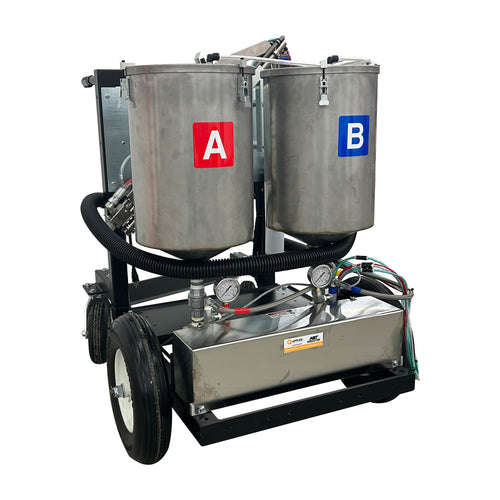
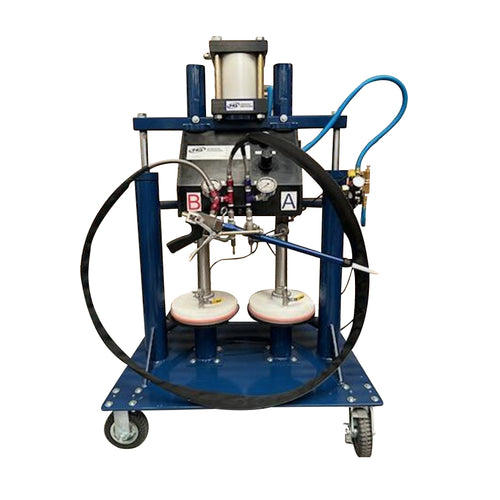
Cartridges can be dispensed using manual, pneumatic, or battery-powered dispensing guns. They can be sufficient for repairs and intermittent work. For larger scale applications, pail and drum pumps that dispense directly from the container without the need to frequently reload can drastically improve efficiency and throughput. The AST SP-5 portable pail pump, for example, is designed for single-component urethanes and is compatible with both MasterSeal SL 1 and Sikaflex-1c SL.
Need a Dispenser?
MasterSeal SL 1 and Sikaflex-1c SL can both provide a reliable and durable performance in horizontal concrete joint applications, but the best choice will depend on the specific requirements of the application.
If you need assistance dispensing either material, we can help. We carry a range of dispensing systems for concrete joint filling and also have the expertise to assist you in the equipment selection process. Contact our team to discuss the details of your job, and we can provide you with an equipment recommendation tailored to your needs.
Dispensing.com is not affiliated with Master Builders Solutions or Sika Corporation. MasterSeal, Sonolastic, Sikaflex, and associated product names are trademarks of their respective owners.